

Mice and Trains


Among many things poetry can do, its unique utility lies in delivering difficult truths in beautiful language. Difficult or otherwise, there aren’t many truths to reveal. For example, we all know that life is a vacation from death. But even this eternal truth repeated again and again exactly like this loses its edge. For people who comprehend the world through language, poetry is a trick that keeps delivering the same truth in newer forms. The ‘what’ might be locked-in but the ‘how’ is poetry’s playground.
It is purely by accident that I came across a poem that described something very similar to what happened to me. Not emotionally, it didn’t remind me of the time I was down as poems generally tend to do, but something more worldly. A few nights ago I was roused from my sleep in the middle of the night by loud honks. It irritated me. I’m sure with time my brain will be trained to tag it as white noise and wouldn’t stupidly alert my senses as a response to it. But that night it irritated me to no end. Something similar happens to the speaker of this Paul Muldoon poem. It starts with registering an irritation and ends with the revelation of an eternal truth. Even a bad poem deserves to be read at least twice, so I would urge you to read this poem at least twice.
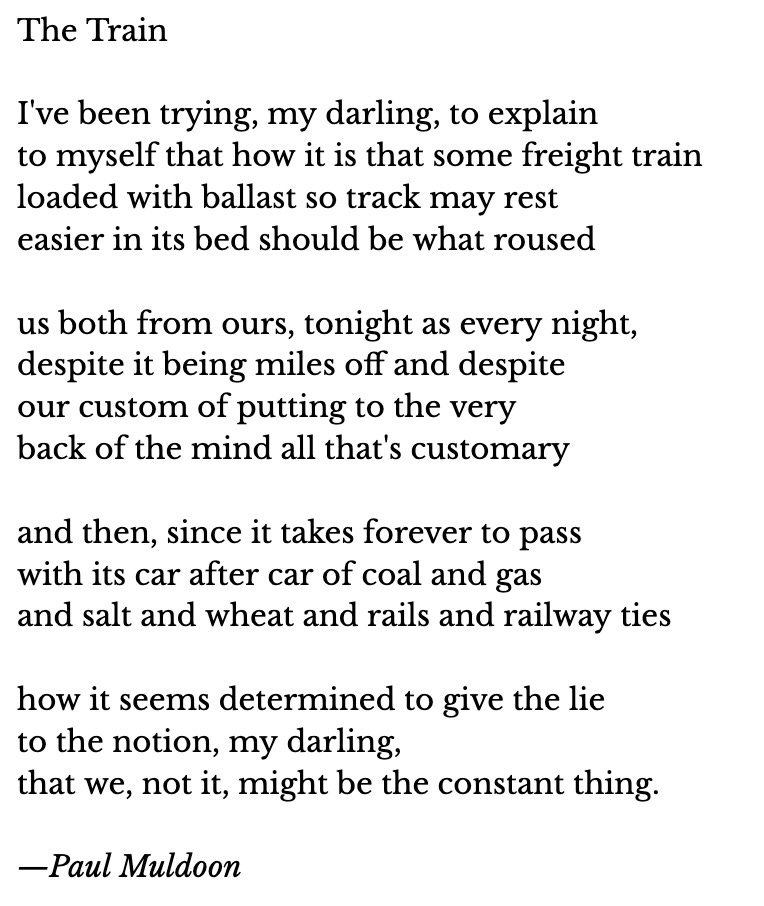
The truth is delivered in the last three lines of this poem. It comes as a bit of a surprise but it doesn’t hit you on the face. Even while reading the last line, the image of the freight train passing by is what you’re thinking about. In this poem, it is the literal experience that helps you arrive at the truth. The image of the freight train taking forever to pass is what links the abstract idea (we are here not for eternity) to the concrete reality of endless irritating sleep-disturbing noise. How slowly, with ease, Paul Muldoon makes us aware of our ephemerality. How temporary we are and how permanent ‘the noise’.
There is another very short poem by Ezra Pound that makes the same truth land in a different way. The poem has no title and given how short it is, you can even memorise it.
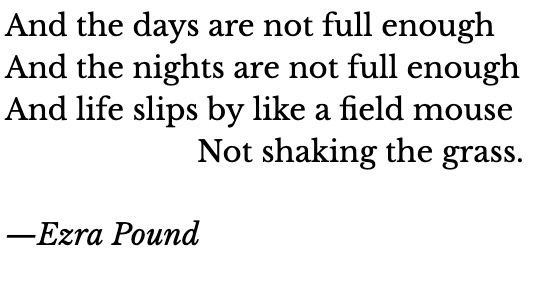
This is a classic case of how to set an expectation and break it. The first two lines are complete in themselves. They are statements. The repetition of ‘full enough’ sets up the expectation of the third line to be of similar type. We are almost convinced that ‘and life slips by like a field mouse’ is the complete statement in itself. Resigned from the context of the poem, it is. By not using ‘full enough’ in this line, Pound has given us some release. But the last line is what gives this metaphor its strength - ‘not shaking the grass’.
Read the poem again and it’s not just the image of a grass field that comes to mind. The image of a grass field where nothing seems to be happening is what comes to mind. The tremors of all that’s happening beneath the grass is not felt by the tip of the grass at all. Not visibly. This too points to the same ugly truth — long before life gives any semblance of existing, it would have passed without anyone noticing. It is very similar to what Muldoon hinted at in his poem. He lands it softly while Pound hits it home swiftly.
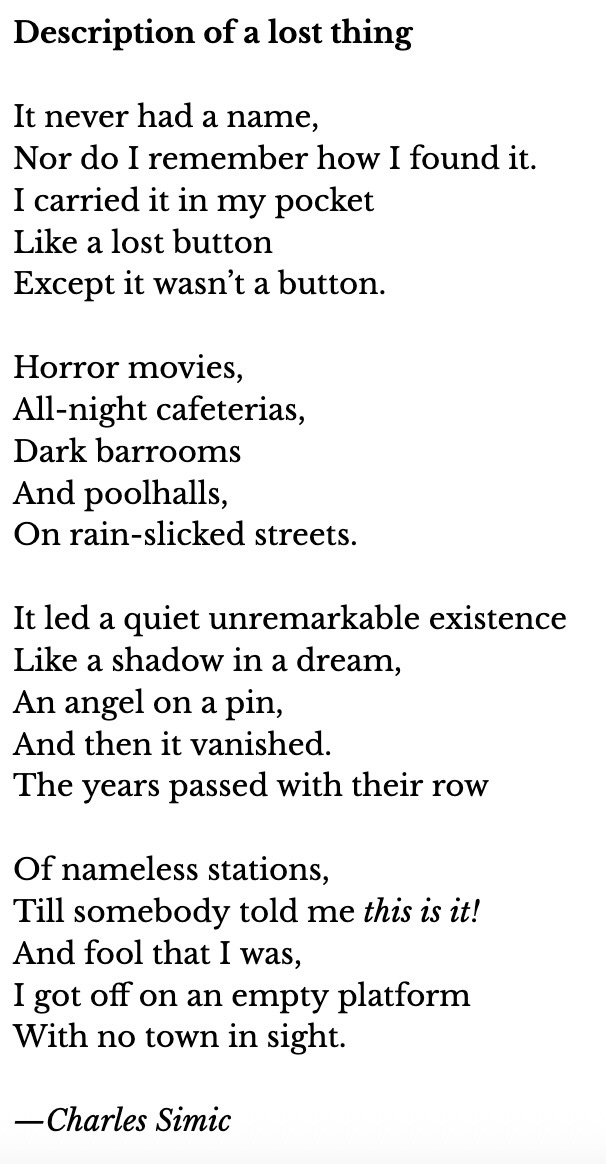
I’ll leave you with another poem that vaguely hints at the same truth but in a roundabout way. It’s by a poet called Charles Simic. Almost everything I write about poetry on ‘Unserious Noticing’ has a space for one of Simic’s poems. There could hardly be a better way of ending an almost-essay.
If you like what you read here on Unserious Noticing, please support me by clicking on the button below. You can choose any amount.
incredible as always
Wonderful piece! The Ezra Pound poem felt most evocative to me, perhaps because it uses such a simple image to deliver the 'truth', as you say.